Showing posts with label Health. Show all posts

Sunday, 10 August 2014

Dehydratation

I hadn't really planned my visit well enough it seems. I came to Cambodia at the beginning of April and I learned that this is one of the hottest time here. I have trouble staying hydrated in the best of conditions. In Cambodia, this became almost impossible.

I did try. I carried a bottle with me all the time. I forced myself to drink from it even when I wasn't thirsty. It wasn't enough and soon it became worrisome.

I know no one wants to hear urine talk, but somehow I feel I can't avoid it. Urine can be a good indicator of severe dehydration and dehydration is something we all face at one point or another of our travels. In my case, as my days in Cambodia went by, I noticed my my urine got darker and darker, until finally it got to be a very dark shade of brown and I couldn't ignore it any longer. I realized that I might just have to go to the hospital. I don't really like hospitals and I didn't really feel confident about hospitals here. So, being pigheaded as I tend to be, I gave myself one day to either somehow manage to improve things or head to the hospital.
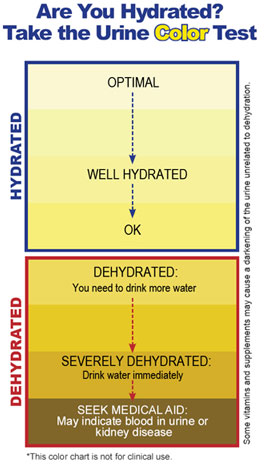
(Reference: Free Drinking Water)


Thankfully, the rooms in my hostel had AC. Not very strong AC, but AC none the less. The rooms were still hot, but it was better than being out there in the sun. So I spent one day inside, forcing myself to drink as much water as I could and taking cold showers to cool off. I rested the rest of the time. Then, the next morning I noticed the color had paled a bit. So I decided to venture outside in the morning and come back at noon to spend the hottest part of the day in the AC. Then at night, I would venture out again. I really calculated my water intake and forced myself to drink every half an hour.

By doing this, I did manage to solve the problem. However, I fully realize this was a very close call for me.

Another good sign of dehydration is the lack of urine. That is one thing I experienced for two days in the Australian Outback (again I was there during the middle of their summer). That time I did drink a lot of water, it just wasn't quite enough. It is said you have to drink one liter per hour when you are in the desert.

Why was I less worried that time in the desert? First, everybody in my group was the same. Second, I knew I had very limited time in the heat. Finally, I didn't have any other symptoms, I felt perfectly fine.

For Cambodia, I knew I was going to remain in those conditions for a while, long enough for it to become a problem. Next, I did feel lethargic and nauseous. To tell you the truth, my body just felt wrong. To me these were other indicators that it was not to be taken lightly and part of the reasons why I was considering seeking medical attention.

You should never overlook hydration, which I know can be quite easy when you travel. As my guide in the Outback of Australia used to say, if you feel thirsty, you are already dehydrated.


Wednesday, 6 August 2014

Doxycycline

When I went for my vaccinations before leaving for this trip, I was given doxycycline as a malaria preventive medication as there was a possibility I would be going to rural areas in risk zones.

A few facts: Malaria is a life-threatening disease caused by Plasmodium parasites transmitted through the bites of infected Anopheles mosquitoes, known as "malaria vectors". These mosquitoes bite between dusk and dawn. Most of the deaths attributed to malaria are among African children. Travelers from malaria-free areas that are not immune to the disease are very vulnerable when they get infected. Malaria is preventable and curable

As travelers, it might be a good idea to sleep with insecticide-treated mosquito nets. I found that in malaria areas, sometimes the nets were provided, sometimes not. You should not take it for granted. Also, insect repellant (bug spray) became my best friend in South East Asia. I don't want to sound all doom and gloom, but let's not forget that mosquitoes transfer other diseases as well, like the West Nile virus and the Dengue Fever (given, it depends on where in the world you are).

To learn more about malaria, like the drug-resistant parasites, click here.

I will be honest with you, I regret taking doxycycline and I eventually did stop it. I know this medication is often prescribed and shows very conclusive results. After all, there is a reason it was prescribed and I fully understand.

The problem was that the side-effects were really getting to me. I would get strong nausea that would last 1 to 2 hours after taking the medication. They would actually prevent me from going out sometimes. The sun sensitivity was also nothing like I had expected when I was first told that this might be a side-effect. I rarely get bad sunburns and when I do, it's because I really wasn't careful. This was something else. Unless I was fully covered I would burn. Sunscreen, no sunscreen, it didn't matter. It was painful and it made my skin look at least 30 years older. Let's be honest, I couldn't really completely cover because of the extreme heat.

(Photo sensitivity: This is what it looks like despite wearing FPS 50 sunscreen)


So yep, there you go, I really regret almost every single dose I took.

Sunday, 13 April 2014

How to treat a snake bite

After my harmless encounter with a venomous snake and my visit to the Reptile Center of Alice Springs, I've decided to share with you the first aid that comes with treating a snake bite.

First, let's start with the things that you shouldn't do :
  • Do not use a tourniquet, there is no need to block off the blood circulation completly and this could do more harm than good by causing more death of tissues
  • Do not attempt to suck the venom out, this could actually be more detrimental than anything, even more so if you do so with your mouth - two patients instead of one anyone?
  • Do not make incision or try to cut out the injection site, but really why would you want to do that, this method like the above have been shown not to work.
  • Do not raise the injection site above the heart
  • Do not apply a cold compress

Now, what you should do :

  • Ensure you are safe first, you won't be much help if you get bitten by a snake as well.
  • Call the emergency services, if you can. If not and if you are with a group, the fastest person should get help.
  • Immobilize the victim, who should avoid movements that would accelerate blood circulation and accelerate the propagation of a potential venom. It is crucial to keep the victim calm. The victim should avoid walking and be transported.
  • Remove constricting object, like rings, since the area will likely swell.
  • Wrap the area tightly with an ace bandage. Start below the bite and work your way up, you want to cover the whole limb. Do not wrap to tightly. If you had a bite on the forearm for example, you would bandage the whole arm, but not close off the fingers, because by monitoring the fingers you can establish if your bandage is too tight.
  •  Splint the limb to immobilize and prevent movement, further preventing propagation of the venom. 
The bandage should look something like this. Once you're done you can splint it as taught in first aid classes.

It's commonly heard that you should bring the snake with you for identification and administration of correct anti venom. However, you should not waste time hunting for the said snake, which could just put the helper in danger. Bring it if it's already dead, but don't waste time hunting it. The doctor can identify the snake with a machine that analyze a sample taken at the bite site or, without said machine, based on the symptoms displayed.

And, finally, just for fun here is a picture taken with a very gentle reptile at the Center, where you can learn all about reptiles and snakes of Australia and beyond. This is where I learned about this piece of first aid.

Wednesday, 18 December 2013

Vaccination

Despite believing that vaccines are generally beneficial, I too sometimes have my doubts. Not so much conspiracy theories or whether you can contract the actual disease from the vaccination. Yet, I am sometime weary of unknown side effects of new vaccination. I also often question myself as to whether a particular vaccine is really necessary – this, I ask myself more often considering how afraid I am of those little needles. Best example would be the flu vaccine: since I'm not in the population at risk, I skip this needle very happily. I'd rather handle the flu than its preventive needle.

This being said, with my plans of going through Australia, Indonesia, Asia, India and Eastern Europe, many vaccines were recommended. I found myself weighting the risks of contracting the disease and the effects of said diseases (some of which are just dreadful) against my fear of needles and the price tag attached to the said vaccines. Note : By price tag, I'm referring to both the price of the vaccine itself and the time taken off of work due to the post­vaccination run down added to the actual phobia reactions, which makes every single needle into a traumatic experience...

Considering my phobia of needles, why would I willingly have 8 immunizations, grouped into 4 different vaccines, for a total of 7 injected doses?

 Now, I don’t particularly feel like oversharing my medical history, but I do believe travel vaccination is a topic worth discussing. So I will share with you which vaccine I agreed to take and the justifications for them.


A bit of context: I already had my Hep B vaccination, so this allowed me to have ViVAXIM, the combined vaccine for the Typhoid Fever and Hep A. I also got the Adacel Vaccine, which targets Diphteria, Pertussis, Tetanus and Polio. These two were considered the bare minimum in terms of vaccination. They amounted to two needles and 210 $, which is much lower than the other two vaccines thanks to OHIP coverage. One way or another, as I walked into the office, I was set on having the Tetanus shot. I decided to go with the advice of the nurse and get ViVAXIM as well.

I gave more thought to the other two recommended vaccines: Ixiaro (Japanese Encephalitis) and Imovax (Rabies). So why was I more concerned about them? In all honesty, probably mainly because of the price tag and the fact they had not been labelled as the essentials.


The Japanese Encephalitis, which is present in the Middle ­East and South East Asia (India, Bangladesh, Thailand, Korea, etc), gets transmitted by mosquitoes (as does the Nile Fever here in Canada).

 Rabies was another one of those diseases affecting the brain. It gets transmitted by animal bite, such as dogs, cats and raccoons (not all of which will appear aggressive, some could be lethargic). The vaccine isn’t a 100% effective against rabies: if you get bitten you must rinse the wound for several minutes with clean water and soap and you have to get treatment quickly. Getting the vaccine doesn't mean you can avoid treatment, but from what I gathered it could lighten the treatment post­exposure.

As with any vaccine, these vaccines may not protect 100% of people who receive it. Really, to me, vaccines are about playing the odds. Looking back, if my private insurance hadn't covered the said vaccines, I might hot have taken the rabies and the ViVAXIM shot. I was set on getting the tetanus shot going in and I do believe I would have gotten the Japanese Encephalitis vaccine regardless.

I'm not pretending to be a doctor or pharmacist and know everything there is to know about vaccines. This information is about what I have understood of the process and the reasoning behind the vaccines I agreed to take. It's about the considerations that came into play when I decided to get travel vaccinations : health, side effects, costs and, in my case, fear of needles. I did go back to the nurse to ask why the rabies vaccine was recommended, if treatment was still required upon exposure. She answered that less vaccines post-exposure would be necessary and that hemoglobin wouldn't be required. This would be the main advantage, as hemoglobin can be hard to find depending where you are and not necessarily safe, since not necessarily tested the way HemaQuebec does here.

If you understand French, the blog Le Pharmachien has this neat strip about vaccination misconceptions. This is a neat blog I follow and I suggest you check it out : http://www.lepharmachien.com/vaccins/.

Other sources I have looked at are :